

A high-level summary of ESM2025 key research outputs and their policy relevance.
ESM2025
The project goal of ESM2025 is to advance the understanding of the Earth system and its response to human activities.
The project aims to develop the next generation of European Earth System Models including a more comprehensive representation of the Earth's response to anthropogenic emissions and human land-use change.
The improved models will help to enhance the consistency of climate and mitigation-relevant processes across Earth System and Integrated Assessment models and provide valuable scientific insights to support successful implementation of the
Paris Agreement.
Results from coordinated simulations with the new models will also provide more robust guidance on future global environmental risks, supporting policies targeting adaptation to global change.
Project details
- Project title: “Earth System Models for the Future” (ESM2025)
- Funding scheme: Horizon 2020 (Grant agreement no. 101003536)
- Duration: 4 years (1 June 2021 – 31 May 2025)
- Project coordinator: Météo France-CNRM, France
- Project website: www.esm2025.eu
- Project key messages: ESM2025 key messages for each target audience
- Presentation video: https://www.youtube.com/watch?v=x3evSTOBE18
12 articles
Sort by
A detailed summary of ESM2025 key research outputs and why they matter.

Drawing on work from six Horizon Europe projects (ESM2025, ClimTip, TipESM, OptimESM, nextGEMS and RESCUE) and a third policy forum held in September 2025, this Earth System Insights briefing summarises the latest evidence on how human emissions are changing the climate and what this means for mitigation and risk management.
This briefing explores the questions raised during the second ESM2025 policy forum.
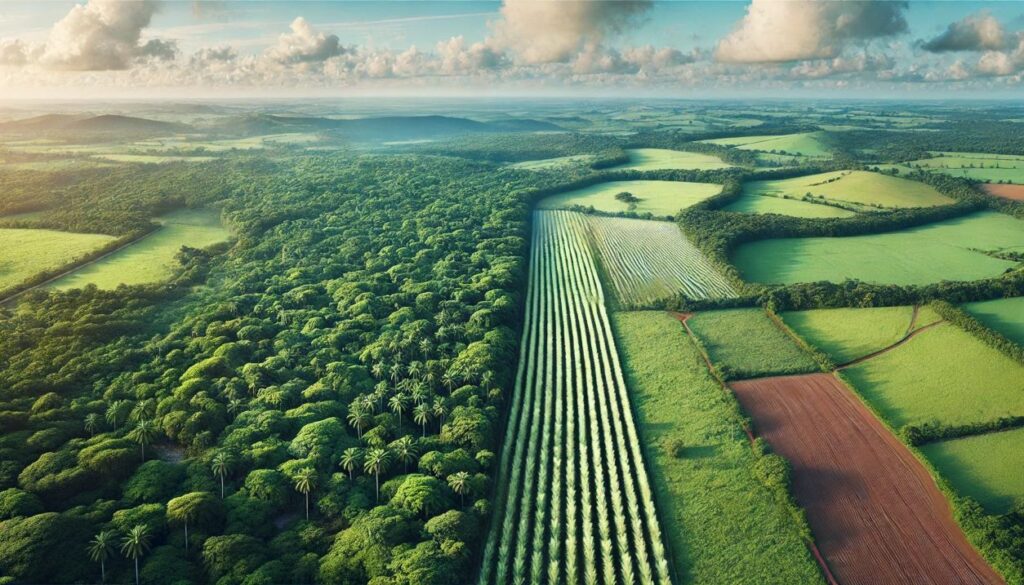
How Earth System Models assess land-based carbon removal (AR, BECCS): carbon-cycle responses, and local climate side-effects; and how Integrated Assessment Models then asses socio-economic constraints that shape decision-ready deployment.

This article gives an overview of the links between Earth System Models and Integrated Assessment Models (including the role of Simple Climate Models) that shape one of the main frameworks used for producing the data that feed IPCC assessments.
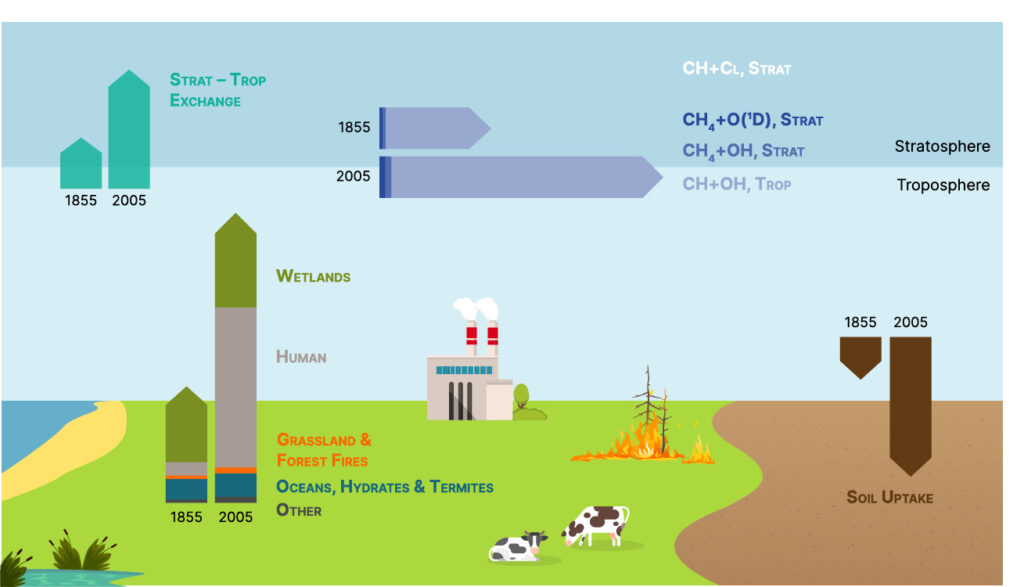
The first fully-coupled methane emission driven Earth system model capable of simulating the impact of anthropgenic forcing on natural environments, as well as the impact of methane emissions and mitigation strategies on air quality.
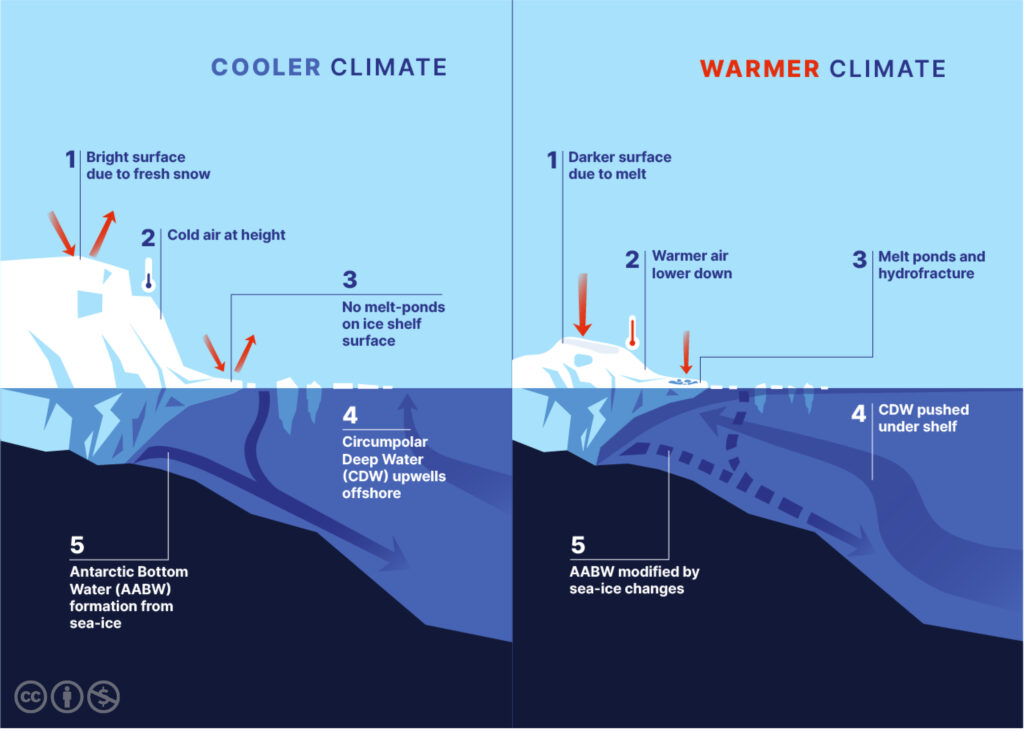
This article gives an overview of the recent advances on the interactive modelling of ice sheet dynamics in Earth System Models, and the implications for reducing the uncertainty of sea-level rise projections, especially when considering multi-centennial timescales of changes or low-likelihood high-impact scenarios.

In this article, we provide an overview of current understanding of the land-to-ocean carbon fluxes. We describe the new conceptual model of the land-to-ocean aquatic continuum (proposed by Regnier et al, 2022, Nature), as well as ongoing work to include this new knowledge in Earth System Models.
This briefing explores the questions raised during the first ESM2025 policy forum and details the contribution of ESM2025 to various policy-relevant topics.
- 1
- 2